The Azores are famous for hydrangea-lined roads, but the plants that tell the archipelago’s deeper ecological story are the native and endemic species of its forests, peatlands, ravines, cliffs and high volcanic slopes. Azorean laurel, juniper, holly, heather, bellflower, rare orchids and dozens of other plants evolved in long isolation on these North Atlantic islands. Many occur nowhere else.
Modern botanical research describes roughly 1,000 vascular plant taxa in the Azores, with close to 300 considered native and around 94 regarded as endemic. The exact taxonomy continues to change as genetic work separates species and clarifies relationships, so older names and counts do not always match current checklists.
That is also why a botanical trip here is not simply about finding colorful flowers. It is about seeing fragments of native Macaronesian vegetation that survived centuries of land conversion and now depend on protected areas, restoration and careful visitor access.
What Makes Azorean Flora So Unusual?

The Azores are part of Macaronesia, the Atlantic biogeographic region that also includes Madeira, the Canary Islands and Cape Verde. The archipelago was never joined to continental Europe. Plants reached the islands through long-distance dispersal by wind, ocean currents, birds and other natural processes, then evolved in isolation.
One of the defining habitats is Azorean laurel forest, or laurisilva. Characteristic trees and shrubs include Azores laurel (Laurus azorica), Azorean juniper (Juniperus brevifolia), Azorean holly (Ilex azorica), Azorean heather (Erica azorica) and Azorean buckthorn (Frangula azorica). Moist high-elevation areas can also support peat bogs, ferns, mosses and other humidity-dependent vegetation.
One taxonomy update worth noting: older sources often refer to the endemic holly as Ilex perado subsp. azorica. The current Azorean Biodiversity Portal lists it as the species Ilex azorica.
Where to See Endemic Plants in the Azores
São Miguel: The Easiest Botanical Starting Point

São Miguel combines wild native habitat with botanical collections that are practical for ordinary travelers. In the east, the protected Pico da Vara and Tronqueira landscape contains important native vegetation and is also the core habitat of the endemic Azores bullfinch, or priolo.
Pico da Vara: the official circular trail reaches São Miguel’s highest point at 1,103 meters. The current route is listed as 7.3 km, about 3 hours and Hard. Access is conditioned and permission is required. The official trail description specifically notes endemic vegetation including Azorean juniper, Ilex azorica, Azorean heather and Sphagnum peat bogs. There is also a current forestry-work alert, so this is a route where checking conditions before departure genuinely matters.
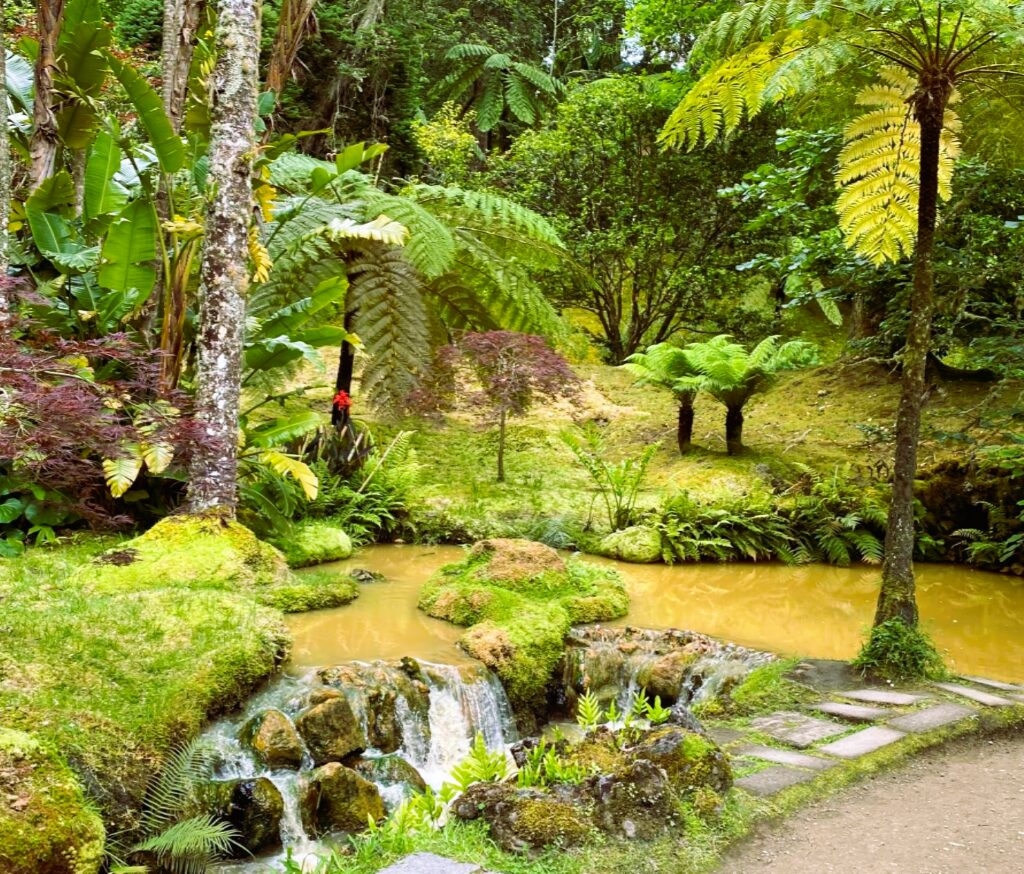
For a much easier introduction, Furnas provides botanical gardens alongside geothermal scenery. Terra Nostra is useful because travelers can see a broad collection of Azorean and international plants without undertaking a mountain hike. Jardim José do Canto in Ponta Delgada provides another historic-garden perspective.
If you are building a nature-focused São Miguel itinerary, combine the east-island native-forest landscape with our Azores birdwatching guide, since the conservation of native plants and the recovery of the priolo are closely connected.
Flores: Wet Highlands, Cliffs and Endemic-Rich Trails

Flores is one of the strongest islands for travelers who want to experience endemic-rich vegetation as part of a broader landscape of waterfalls, crater lakes, cliffs and wet uplands. Morro Alto reaches about 911 meters, and the island’s elevation and rainfall create ideal conditions for humidity-loving native vegetation.
The Great Route of Flores is the island’s major long-distance route. Official trail information lists it as a 47 km, 18-hour, Hard route divided into two stages and specifically notes endemic-rich vegetation along the northeast coast and western cliffs. However, Stage 2 is currently closed, so do not plan the full route from an older guidebook without checking the live status.
Flores also demonstrates why there is no single “best flowering month” for every endemic species. Blooming periods vary by plant, elevation and weather. Late spring and early summer can be rewarding, but the island’s native forests, peatlands and evergreen species are worth seeing throughout the year when conditions allow.
Faial: See Conservation Happening in Real Time

Faial is particularly valuable because the island’s Botanic Garden is not only an attraction; it is part of the conservation infrastructure of the Azores. The Pedro Miguel centre, created in 1995, covers about 60,000 m² and functions as a micro-reserve for humid and hyper-humid Azorean laurel-forest habitats.
The Faial Botanic Garden also serves as a propagation centre for native and endemic species used in restoration projects across the archipelago. Recent projects have produced plants for population reinforcement on Faial, Graciosa, São Jorge and other islands.
One correction to older versions of this article: the famous Platanthera azorica should not be presented simply as a Faial-and-São Jorge orchid. Current regional conservation material identifies the Central Plateau of São Jorge as the exceptional place to associate with this species and describes it as the rarest orchid in Europe.
Pico: Flora Across a Huge Elevation Gradient
Pico rises to 2,351 meters, Portugal’s highest point, creating the archipelago’s most dramatic elevation gradient. Vegetation changes noticeably as altitude, wind exposure, temperature and volcanic substrate change.
Azorean heather (Erica azorica) is a particularly adaptable endemic. Regional flora guidance records it from the coast to about 1,700 meters on Pico. That is impressive, but it should not be described as growing all the way to the summit. Upper Pico becomes increasingly severe and sparsely vegetated.
Lower on the island, native vegetation exists alongside the famous human-shaped vineyard landscape. The contrast is useful: Pico shows both the ecological adaptation of native plants and the way people learned to cultivate crops within a harsh basalt environment.
São Jorge, Graciosa and Corvo

São Jorge deserves more attention than the generic “fajãs and cheese” description it often receives. Its Central Plateau protects important peatland and endemic-flora habitat, including rare plants such as Chaerophyllum azoricum, Ammi trifoliatum, Tolpis azorica, Euphrasia grandiflora and Platanthera azorica. The area is also part of a Ramsar site and Natura 2000.
Graciosa has active coastal-flora restoration. In 2026, native and endemic plants propagated by the Faial Botanic Garden were planted on Praia and Baixo islets, including Euphorbia azorica and Myosotis maritima. Later work reinforced populations of the endemic Azorean bellflower, Azorina vidalii.
Corvo is tiny, but its isolation and protected caldera landscape make it valuable for biodiversity. It is better to describe that ecological importance directly than to use unsupported claims such as “the highest per-capita endemism rate” in the archipelago.
Endemic Plants Worth Learning Before Your Trip
| Plant | Scientific name | Where you may encounter it | Why it matters |
|---|---|---|---|
| Azores laurel | Laurus azorica | Native forest on several islands | A characteristic tree of Azorean laurel-forest habitat |
| Azorean juniper | Juniperus brevifolia | Higher native forest and exposed uplands | One of the defining endemic trees of the archipelago |
| Azorean holly | Ilex azorica | Laurisilva, often above lower elevations | Current taxonomy recognizes it as an Azores-endemic species |
| Azorean heather | Erica azorica | Coast to high elevations, depending on island | Highly adaptable endemic shrub/tree and restoration species |
| Azores bellflower | Azorina vidalii | Coastal habitats on several islands | Protected endemic actively reinforced by conservation projects |
| Azorean buckthorn | Frangula azorica | Native woodland and restoration areas | Important native-forest species used in habitat recovery |
| Azorean orchid | Platanthera azorica | Most strongly associated with São Jorge’s Central Plateau | Regional sources describe it as Europe’s rarest orchid |
What Threatens Native Azores Flora?

The biggest historic change has been habitat conversion since settlement: native vegetation was cleared or altered for agriculture, grazing, timber and settlements. Today, invasive alien plants remain one of the central conservation challenges.
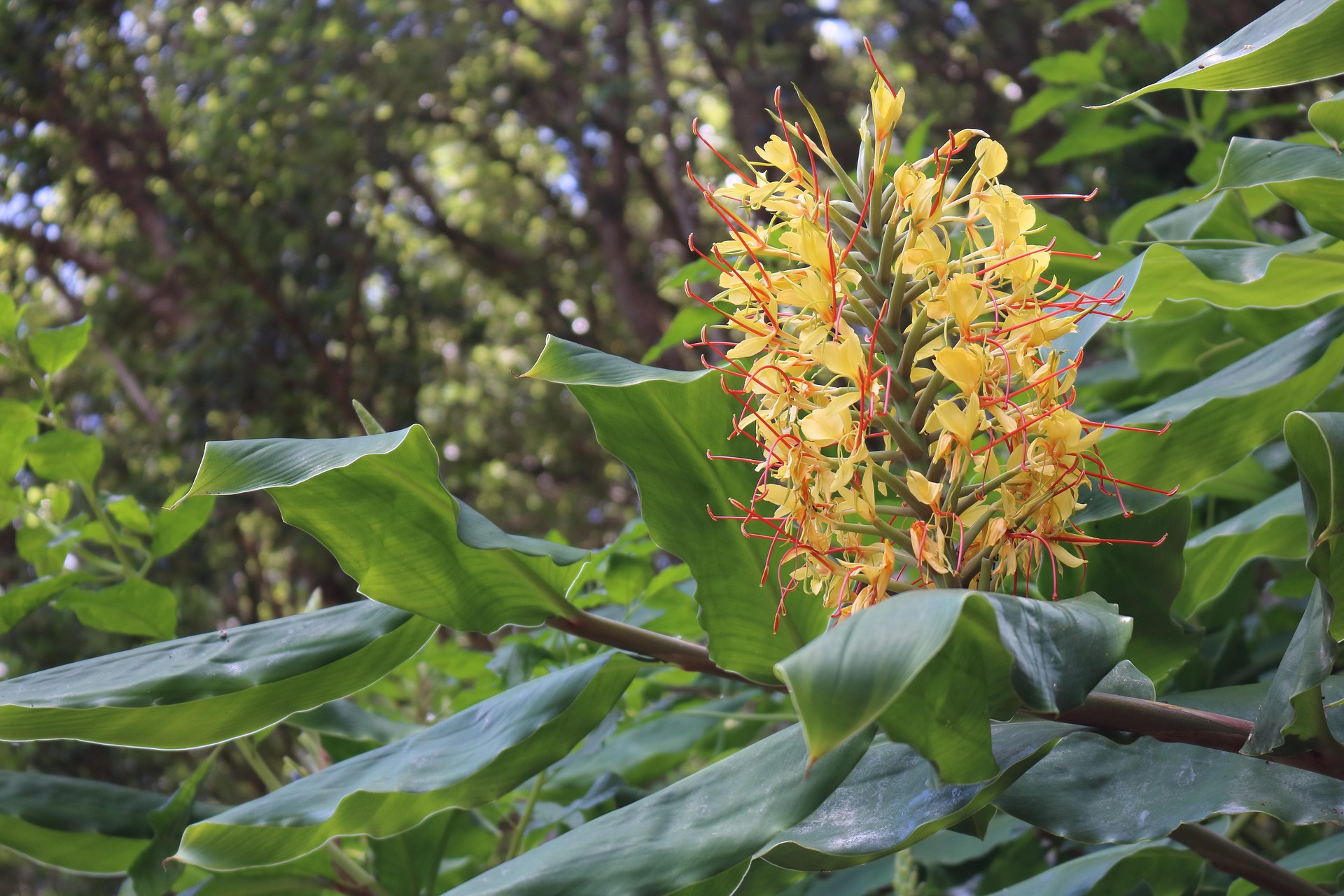
Kahili ginger (Hedychium gardnerianum) and sweet pittosporum (Pittosporum undulatum) are among the conspicuous invasive species targeted by restoration programs. Japanese cedar (Cryptomeria japonica) is different: it was widely planted as a forestry tree and is not botanically equivalent to the native forest it replaced. In some conservation areas, restoration work includes removing planted cryptomeria so native vegetation can recover.
Climate and elevation add another challenge. Many high-elevation plants depend on cool, wet, foggy conditions. On islands with limited land above them, species cannot simply migrate indefinitely uphill as conditions change.
LIFE IP AZORES NATURA
The EU-supported LIFE IP AZORES NATURA program is the largest integrated nature-conservation project undertaken in the archipelago. Its budget is about €19 million, and its work covers all nine islands. Project objectives include restoring roughly 1,500 hectares, improving the status of protected habitats and species, controlling invasive plants, and conserving seeds from 80% of Azores endemic plant species.
By the 2025 FloraMac reporting point, the project had identified 102 new populations across 19 target plant species and planted more than 44,000 individuals. Current 2026 work continues to reinforce endemic populations on islands including Faial, Graciosa and São Jorge.
How to Experience Endemic Flora Responsibly
- Stay on marked trails. Peatlands, rare plants and restored areas can be damaged by a few footsteps.
- Do not pick plants or collect seeds. Some species are rare, protected or difficult to identify correctly.
- Check trail status before leaving. Weather, forestry work, erosion and conservation measures can restrict access.
- Use gardens to learn first. Botanical collections make it easier to recognize plants later in wild habitat.
- Use a knowledgeable guide for specialist goals. Rare orchids and localized endemics should not be approached as a geocaching exercise.
- Clean hiking footwear between islands and trails. Reducing soil and seed transfer is a simple way to limit the accidental spread of invasive plants.
If hiking is central to the trip, start with our Best Hiking Trails in the Azores guide. If you want to combine several botanical landscapes, our Azores island-hopping guide explains how to group islands without spending the vacation constantly in transit.
Azores Endemic Flora FAQs
How many endemic plant species are there in the Azores?
Modern research commonly describes around 80 endemic vascular plant species among roughly 300 native taxa. The exact count can change as taxonomy is revised and genetic studies identify previously unrecognized diversity.
Are hydrangeas native to the Azores?
No. Hydrangeas are one of the most recognizable plants in Azores travel photography, but they are introduced ornamental plants rather than endemic Azorean flora.
Where is the best place to see native forest on São Miguel?
The protected eastern highlands around Pico da Vara and Tronqueira contain some of São Miguel’s most important native habitat. The official Pico da Vara trail currently requires permission, so confirm access and trail conditions before going.
Where can I see the rarest orchid in Europe?
Regional conservation sources identify Platanthera azorica with the Central Plateau of São Jorge and describe it as Europe’s rarest orchid. It is a conservation species, not something travelers should leave marked routes to search for independently.
What is the best season for endemic flowers?
There is no single flowering month for all endemic plants. Many species flower in spring or early summer, but timing varies by species, island, altitude and annual weather. Native evergreen forest and endemic shrubs can be appreciated year-round.
Is Pico da Vara open?
As of the September 2026 review, the official trail site lists Pico da Vara as conditioned access and requires visitors to obtain permission. It also carries an alert related to forestry work and heavy machinery near the first part of the route.
Want to include native forest, botanical gardens or endemic-rich hiking in your Azores trip? Tell our travel specialists which islands and activities interest you, and we can build them into a practical itinerary.
Compare Azores Packages Plan My Azores Vacation

Eunice Costa has served as Travel Director of Portugal Online Corp., Azores.com (Azores Travel and Tours) since 1996. Born in the Azores and now based in California, she brings more than 30 years of experience promoting the Azorean Islands and creating thoughtfully designed tour packages, especially tailored for the U.S. and Canadian markets, that combine exceptional experiences with great value. Through her contributions to the Azores.com blog, Eunice shares her deep knowledge and passion for all nine Azorean Islands, helping travelers discover the very best of this unique destination.