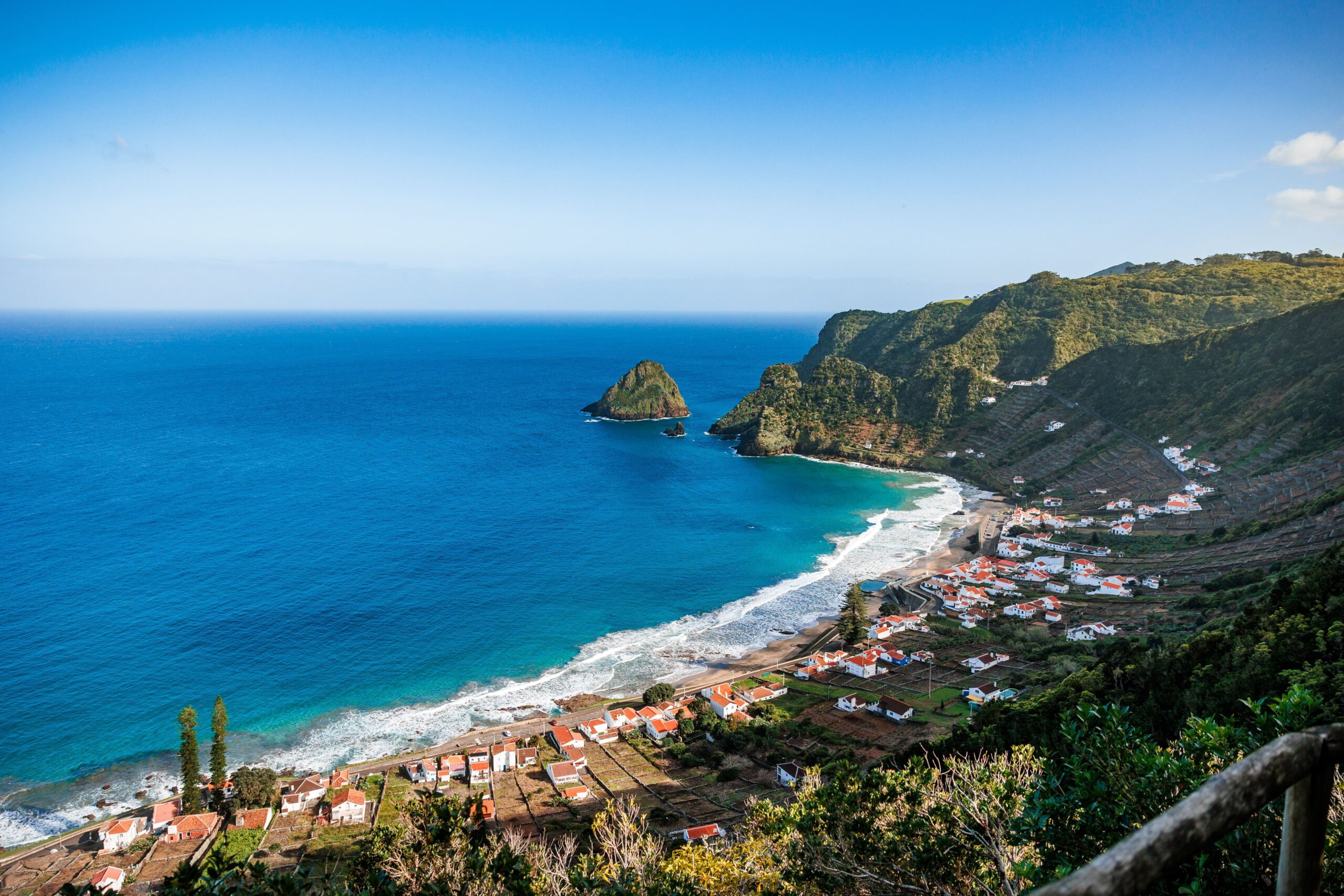
The Azores are often described in travel writing as the “Hawaii of Europe.” The comparison makes sense at first glance: both are green volcanic archipelagos with dramatic coastlines, whale watching, surfing, hiking and black-sand beaches. But they are not interchangeable destinations.
The most useful way to compare the Azores vs Hawaii is to ask what kind of island vacation you actually want. The Azores are cooler, more temperate and strongly shaped by Portuguese and Azorean culture. Hawaiʻi is tropical, has a much larger beach-resort tradition and offers the possibility of seeing activity associated with some of the world’s most active volcanoes. The similarities are real, but the differences matter more when planning your trip.

Think crater lakes, geothermal bathing, green hiking, whale watching, small towns and a Portuguese island culture, with single- or multi-island itineraries.
Think warmer sea-level weather, a much stronger classic beach-and-resort focus, major surf culture and the volcanic landscapes of Hawaiʻi Volcanoes National Park.
Azores vs Hawaii at a Glance
| Question | Azores | Hawaiʻi | Best fit |
|---|---|---|---|
| Climate | Temperate maritime; mild but changeable, with rain possible year-round | Tropical and warmer at sea level, with strong local microclimates | Hawaiʻi for dependable warmth; Azores for a cooler active trip |
| Volcanoes | Calderas, crater lakes, fumaroles, lava caves, geothermal areas and young eruption landscapes | Shield volcanoes, lava fields and some of the world’s most active volcanoes | Azores for variety in compact landscapes; Hawaiʻi for active-volcano scale |
| Beaches | Dark-sand beaches, rocky shores and natural ocean pools; not primarily a beach-resort destination | Far broader choice of famous sandy beaches, including white and black sand | Hawaiʻi for a beach-first vacation |
| Hiking | Caldera rims, coastal paths, waterfalls, fajãs and volcanic ridges across nine islands | Rainforests, ridges, lava fields, alpine terrain and volcanic national-park routes | Both; choose by climate and terrain |
| Whales | Year-round cetacean watching with important seasonal changes in species | Humpback whales are the signature seasonal experience, especially December–May | Depends on season and species interest |
| Surfing | Established Atlantic surf scene, including São Miguel and other islands | Deep cultural connection to surfing and globally famous big-wave locations | Hawaiʻi for surf heritage and scale |
| Thermal bathing | A defining São Miguel experience, especially around Furnas and Ferraria | Volcanism is highly visible, but geothermal bathing is not the same mainstream visitor experience | Azores for hot-spring and thermal-pool travel |
| Island hopping | Nine islands in three groups; trips may combine flights and Central Group ferries | Inter-island flights are the main connection between principal visitor islands | Both require deliberate island-by-island planning |
1. Both Are Volcanic Islands, but the Geology Is Very Different
Volcanism is the strongest visual reason for the “Hawaii of Europe” comparison. In the Azores, visitors encounter huge collapse calderas such as Sete Cidades, crater lakes, fumaroles in Furnas, lava tubes, the 1957–58 Capelinhos eruption landscape on Faial and Mount Pico, Portugal’s highest mountain.
Hawaiʻi formed over a volcanic hot spot as the Pacific Plate moved above it. On the island of Hawaiʻi, Kīlauea and Mauna Loa are among the world’s most active volcanoes. That means the Hawaiian volcano experience can include enormous shield volcanoes and, when conditions allow, visible eruptive activity. The Azores are volcanically active too, but a normal visitor experience is about volcanic landscapes, caves and geothermal features, not standing beside an eruption.

2. The Azores Are Mild, but They Are Not Tropical Like Hawaiʻi
This is one of the biggest differences. The Azores sit in the temperate North Atlantic. Their maritime climate is generally mild, humid and changeable, and clouds or rain can occur in any month. Hawaiʻi is much warmer at sea level and has a tropical climate with pronounced local differences between wet, dry, coastal and high-elevation areas.
For perspective, official Portuguese climate normals for Ponta Delgada put the monthly mean near 15°C (59°F) in mid-winter and about 23°C (73°F) in August. Hawaiʻi tourism guidance describes average daytime sea-level temperatures around 78°F (25.6°C) in winter and 85°F (29.4°C) in summer. If warm beach weather is the priority, Hawaiʻi has the clear advantage. If you prefer mild hiking weather and do not mind fast-changing Atlantic conditions, the Azores can be an excellent fit.
See our Azores Weather by Month guide before choosing travel dates.
3. Both Are Excellent for Whale Watching, but the Seasons Differ
Both archipelagos are major whale-watching destinations, but they should not be sold as identical experiences. In the Azores, cetaceans occur throughout the year and the species mix changes by season. Sperm whales and several dolphin species can be encountered in different seasons, while large baleen whales are especially associated with spring migration.
Hawaiʻi’s signature whale season is centered on North Pacific humpback whales, which return to Hawaiian waters to breed and calve, with the official visitor season generally described as December through May. If whale watching is central to your Azores plans, use our current Azores whale-watching guide rather than relying on a single success-rate statistic.
4. You Can Surf in Both, but Hawaiʻi Is in a Different League
The original article accidentally skipped reason number four even though it included two surfing paragraphs. The Azores absolutely have a real surf scene: São Miguel has established breaks, schools and equipment rental, and official Azores tourism resources list surf spots across several islands.
What should be removed is the claim that the Azores simply “rival” Hawaiʻi’s famous surf breaks. Surfing is deeply tied to Hawaiian history and culture, and Oʻahu’s North Shore is one of the world’s best-known big-wave areas. Travelers can choose the Azores for Atlantic surf in a smaller island setting without pretending the two destinations have the same surf scale or legacy.
5. Hiking Is One of the Strongest Similarities
For hikers, the comparison is much more useful. Both destinations combine steep volcanic terrain, lush vegetation, coastal routes and dramatic elevation changes. The difference is in the character of the landscapes.
The Azores trail network includes caldera rims, waterfalls, hydrangea-lined country paths, high volcanic ridges, coastal fajãs and routes across old lava terrain. Hawaiʻi adds tropical rainforest, dry lava fields, high-elevation landscapes and major volcanic park routes. Neither destination should be treated as universally easy: weather, mud, exposure, trail closures and elevation can change the difficulty significantly.

For current routes and difficulty guidance, see our recovered Best Hiking Trails in the Azores guide.
6. Both Have Distinctive Island Food, but the Cuisines Are Not Comparable Copies
Island geography shapes food in both places, but it is better to appreciate each cuisine on its own terms. In the Azores, travelers encounter Atlantic seafood, local cheeses, beef, breads and pastries, São Miguel pineapple and tea, Pico wine, and Cozido das Furnas cooked with geothermal heat.
Hawaiian food reflects Native Hawaiian traditions alongside the many cultures that have shaped modern Hawaiʻi. Calling one cuisine a mirror of the other flattens two very different histories. The useful similarity is simply that food is part of understanding island identity rather than an add-on to the scenery.
7. Both Have Volcanic Beaches, but Hawaiʻi Is the Stronger Beach Destination
Dark volcanic sand occurs in both archipelagos, so the visual comparison is fair. The travel experience is different. The Azores have attractive black- and dark-sand beaches, rocky coves and many natural ocean pools, but a typical Azores itinerary is built around scenery, hiking, geothermal landscapes, villages and road trips rather than spending every day on a broad sandy beach.
Hawaiʻi offers a much wider range of famous beach environments, including white-, black- and even red-sand shores. If your ideal vacation starts with long beach days and warm-water swimming, Hawaiʻi is usually the better match. If the coast is one element of a nature-focused trip, the Azores may suit you better.
8. The Green Scenery Can Look Similar, but the Azores Are Not a Tropical Garden
Photographs are partly responsible for the “Europe’s Hawaii” nickname. Green crater walls, waterfalls, large-leaved plants and ocean cliffs can create a visual resemblance. But the old article went too far by describing the Azores as having “similar tropical vegetation.”
The Azores are temperate oceanic islands with native Macaronesian vegetation and many introduced species. Hydrangeas, Japanese cedar, ornamental flowers, bananas and palms may all appear in the landscape, but that does not make the archipelago tropical. Hawaiʻi supports true tropical ecosystems as well as dry and alpine environments created by elevation and rain-shadow effects.
9. Both Reward Divers and Snorkelers, but the Water Feels Very Different
Volcanic coastlines continue below the surface in both destinations. The Azores offer lava formations, offshore banks, reefs, wrecks and encounters with Atlantic pelagic species. Hawaiʻi adds warm tropical water, coral environments and its own distinctive marine life.
The biggest practical difference is temperature and seasonality. Azorean water is cooler and conditions vary across the year, while Hawaiʻi is generally warmer for casual snorkeling. Divers considering the Azores should choose island, site and season around experience level rather than assuming a tropical diving environment. Our Azores scuba-diving guide explains the main islands and dive styles.
10. Both Have Strong Island Identities, but Their Cultures Are Fundamentally Different
The old phrase “a strong cultural identity that remains untouched” should be retired. No living culture is “untouched,” and comparing Azorean and Hawaiian identity as if they were parallel versions of the same island culture is misleading.
The Azores are an autonomous Portuguese archipelago with centuries of settlement, seafaring, agriculture, Catholic festivals, distinctive island traditions and close links to Azorean communities abroad. Hawaiʻi has an Indigenous Polynesian culture, the Hawaiian language, deep relationships between people and place, the history of the Hawaiian Kingdom and its later political history within the United States. Both deserve to be experienced as cultures in their own right, not as scenery attached to beaches and volcanoes.
11. Both Promote More Responsible Tourism, but the Programs Are Different
There is evidence behind this comparison, but it needs specificity. The Azores have pursued formal sustainable-destination certification and regional sustainability commitments. Hawaiʻi tourism promotes mālama—care for the land, ocean, wildlife and communities—and offers visitor opportunities connected with stewardship and giving back.
That does not mean every hotel, tour or visitor behavior in either destination is automatically sustainable. A better traveler standard is practical: stay on marked trails, respect protected areas and wildlife rules, support local businesses, reduce waste and treat residential communities as places where people live rather than as attractions.
12. The Azores Have the Stronger Thermal-Bathing Experience
This final comparison is where the Azores offer something that many Hawaii-focused travelers may not expect. São Miguel has a long-established visitor experience around hydrothermal water: Furnas has iron-rich thermal pools and fumaroles, while Ferraria combines geothermal influence with the Atlantic coast. Graciosa also has thermal resources at Carapacho.
Hawaiʻi has far more dramatic active-volcano potential, but hot-spring soaking is not a defining mainstream part of a Hawaiian vacation in the way thermal bathing can be on São Miguel. Travelers who want to combine volcanic scenery with a soak should give the Azores particular consideration.
Which Is Better for You: the Azores or Hawaiʻi?
Choose the Azores for…
Crater lakes, green road trips, geothermal pools, Atlantic wildlife, walking trails, smaller towns and a trip that feels distinctly Portuguese and Azorean.
Choose Hawaiʻi for…
Warmer tropical weather, classic beach time, Hawaiian surf culture, broad resort choice and the possibility of experiencing the extraordinary scale of Hawaiʻi’s active volcanic landscapes.
Choose either for…
Volcanic scenery, hiking, whale watching, surfing, diving, dramatic coastlines and an island trip where weather and geography shape each day.
Cost should not be the deciding factor without checking your actual dates. Airfare, lodging, rental cars and activities change by season, departure city and island combination. The old claim that the Azores are simply a cheaper alternative to Hawaiʻi is too broad to remain evergreen.
Geography can be a more useful filter. The Azores sit in the North Atlantic between Europe and North America and can fit naturally into a Portugal trip. Hawaiʻi sits deep in the Pacific and is generally more convenient to combine with travel from western North America or the Pacific region. Your starting point can change the practical answer as much as the scenery.
If the Azores Sound Right, Start With the Island Choice
For most first-time visitors comparing the Azores with Hawaiʻi, São Miguel is the simplest starting point. It combines Sete Cidades, Furnas, Lagoa do Fogo, thermal bathing, beaches, hiking, whale-watching departures and the archipelago’s largest range of accommodations and services.
If you have more time, add islands for a specific reason rather than simply increasing the count. Pico adds Portugal’s highest mountain and volcanic vineyards; Faial adds Capelinhos; Terceira adds Angra do Heroísmo and Algar do Carvão; Flores adds waterfalls and crater-lake scenery. Compare all nine in our Azores Islands guide.
Then use How Many Days in the Azores, our Azores Island Hopping guide and Getting Around the Azores to make sure the route works in real travel time.
Azores vs Hawaii FAQs
Why are the Azores called the Hawaii of Europe?
The nickname comes from visual and activity similarities: both are volcanic island groups with green mountains, dramatic ocean scenery, waterfalls, hiking, whale watching, surfing and dark volcanic beaches. It is useful shorthand, not an exact comparison of climate, culture or travel style.
Are the Azores tropical?
No. The Azores have a temperate maritime climate. They are mild for their North Atlantic latitude, but they are cooler, wetter and more changeable than tropical Hawaiʻi.
Are the Azores warmer than Hawaiʻi?
No. Hawaiʻi is generally much warmer at sea level throughout the year. Summer in the Azores can be pleasantly warm, but travelers should still expect changing cloud, wind and rain conditions.
Do the Azores have active volcanoes?
Yes. The Azores are an active and monitored volcanic region. Visitors usually experience crater landscapes, fumaroles, geothermal springs, lava caves and historic eruption terrain rather than an ongoing eruption.
Can you see an active volcano in Hawaiʻi?
Hawaiʻi Volcanoes National Park protects Kīlauea and Mauna Loa, two of the world’s most active volcanoes. Eruptive activity changes over time, and visible lava is never something to assume months in advance. Check the National Park Service and USGS status for your actual travel dates.
Are Azores beaches like Hawaii beaches?
Only partly. Both have volcanic dark-sand shores, but Hawaiʻi has a much larger range of classic sandy beaches and a warmer beach-oriented climate. The Azores are better approached as a nature and touring destination that also has beaches and natural pools.
Is whale watching better in the Azores or Hawaiʻi?
Neither is universally “better.” Hawaiʻi is famous for its winter humpback season. The Azores offer year-round cetacean watching with a broader seasonal mix of resident and migratory species. Choose based on your travel month and the animals you hope to see.
Are the Azores cheaper than Hawaiʻi?
Sometimes, but it should not be stated as a rule. Trip cost depends on origin airport, travel dates, hotel level, rental cars, activities and how many islands you add. Compare the complete trip for your dates instead of relying on a generic destination-cost claim.
Which Azores island feels most like Hawaiʻi?
São Miguel is the easiest answer for a first-time visitor because it combines lush volcanic scenery, crater lakes, waterfalls, black-sand beaches, geothermal areas, surfing and whale watching. Flores can look even more dramatically green and waterfall-filled, while Pico has the archipelago’s most dominant volcanic mountain.
How many days should I spend in the Azores?
Seven days is a strong first trip for one island in depth or a carefully chosen two-island combination. Ten to fourteen days works better when you want several islands without turning the vacation into a sequence of airports, ferry terminals and hotel changes.
Plan an Azores Vacation That Fits the Experience You Want
The Azores do not need to be “Europe’s Hawaii” to be worth the trip. The comparison is most useful as a starting point: if volcanoes, ocean scenery, hiking and wildlife are what attract you to Hawaiʻi, the Azores can offer many of those themes in a cooler Atlantic setting with a completely different culture and travel rhythm.
Thinking about the Azores instead of—or in addition to—Hawaiʻi? Compare current Azores vacation styles, or tell our travel specialists the islands, pace and experiences that matter most to you.
Compare Azores Vacation Packages Plan My Azores Vacation

António Coelho has served as Managing Director of Portugal Online Corp., Azores.com, an Azores travel and tour company, since 1996. Born in the Azores and now based in California, António helps create exceptional Azorean travel experiences tailored to the U.S. and Canadian markets. He is also a travel writer, photographer, and contributor to Azores.com, where he produces regional guides, itineraries, and practical travel advice. His published work highlights outdoor adventures, family travel, and wildlife watching across the nine Azorean Islands, helping travelers explore the destination with confidence and insight.