Travel Consultants
Is your time too precious to spend long hours searching for the perfect holiday in the Azores? Looking for expert help in organizing your trip? Hire an Azores.com Travel consultant.


Yes, the Azores can support a demanding triathlon training block, provided you arrive with flexibility rather than a fixed plan. The archipelago gives you pool and supervised ocean swimming, long volcanic climbs by bike, trail and track running, and outdoor conditions in every season. São Miguel works best as your first base.
This guide moves in the order you will plan: whether the Azores suit triathlon training at all, where to base yourself, where to swim, what cycling the islands support, where to run for endurance and speed, how a seven-day block fits together, what to reserve and pack, and the safety limits that should shape every session. The honest catch comes first. The Azores is a self-directed training environment, not a turnkey resort camp, and Atlantic weather changes by the hour.
The Azores can support a demanding, scenic triathlon training block. You get pool and supervised ocean swimming, sustained volcanic climbing by bike, road and trail running, and an eight-lane track. The islands reward flexible, self-directed athletes far more than travellers who expect a turnkey camp or guaranteed dry weather.
The Azores is a nine-island Portuguese archipelago in the mid-Atlantic, roughly 1,400 km west of Lisbon. Volcanic terrain defines the training: climbs rise steeply, the ocean sits a few minutes from most towns, and rural roads stay quiet. Sea-surface temperature ranges from about 15.7 C in March to about 23.4 C in August (Surf-forecast and SeaTemperatu.re, verified June 2026), so open-water work is realistic from roughly June to October and the pool covers the rest of the year.
This destination suits the athlete who can move a session when a wind warning lands, who is comfortable swimming supervised rather than solo, and who treats a long climb as the point rather than a problem. It suits clubs and coaches who want a quiet, scenic block with controlled venues nearby. It does not suit anyone expecting flat race-pace roads on demand, a packaged triathlon camp with daily support, or warm, dry weather every day. Real athletes ask exactly these questions: one Slowtwitch user planning weeks in Feteiras and Povoação asked simply where to ride, which trails to run, and whether pools were available (Slowtwitch forum, 2023).
The table below maps each discipline to a verified venue, value, and watch-out. Treat it as your planning spine for the sections that follow.
|
Discipline |
Primary venue or route |
Verified values |
Best window |
Watch-outs |
|
Swim, pool |
Piscina das Laranjeiras, Ponta Delgada |
25 m, 6 lanes, gym, sauna |
Year-round |
Confirm public lane times |
|
Swim, open water |
Designated bathing areas plus guided sessions |
Sea 15.7 C Mar to 23.4 C Aug |
Jun to Oct |
Swell, currents; never solo; check IPMA |
|
Bike, road |
Biking Azores network, 60+ routes |
Nordeste-PDL 83 km, 1,782 m, Black |
Apr to Oct drier |
Open traffic, steep descents, cobbles |
|
Bike, climbing |
Ponta Delgada to Lagoa do Fogo |
Approx 50 km, high point approx 1,349 m |
Year-round |
Wind and cloud at altitude |
|
Run, track |
Laranjeiras synthetic track |
8 lanes, 400 m |
Year-round |
Confirm access and timetable |
|
Run, trail |
Azores Trails official network |
Graded routes, live status |
Year-round |
Mud, exposure; check route status |
|
Run, flat |
Ponta Delgada and Lagoa waterfront |
Limited long flat stretches |
Year-round |
Field-check distances |
Source: Azores Sports Parks, Biking Azores, IPMA, and Surf-forecast. Verified 25 June 2026. Recheck volatile values before travel.
São Miguel is the most practical first base. The island combines the archipelago’s main airport at Ponta Delgada, the widest accommodation choice, official road-cycling routes, cycling support services, a 25-metre pool, and an eight-lane athletics track. Basing near Ponta Delgada and the Laranjeiras complex shortens the transfers between hard sessions and recovery.
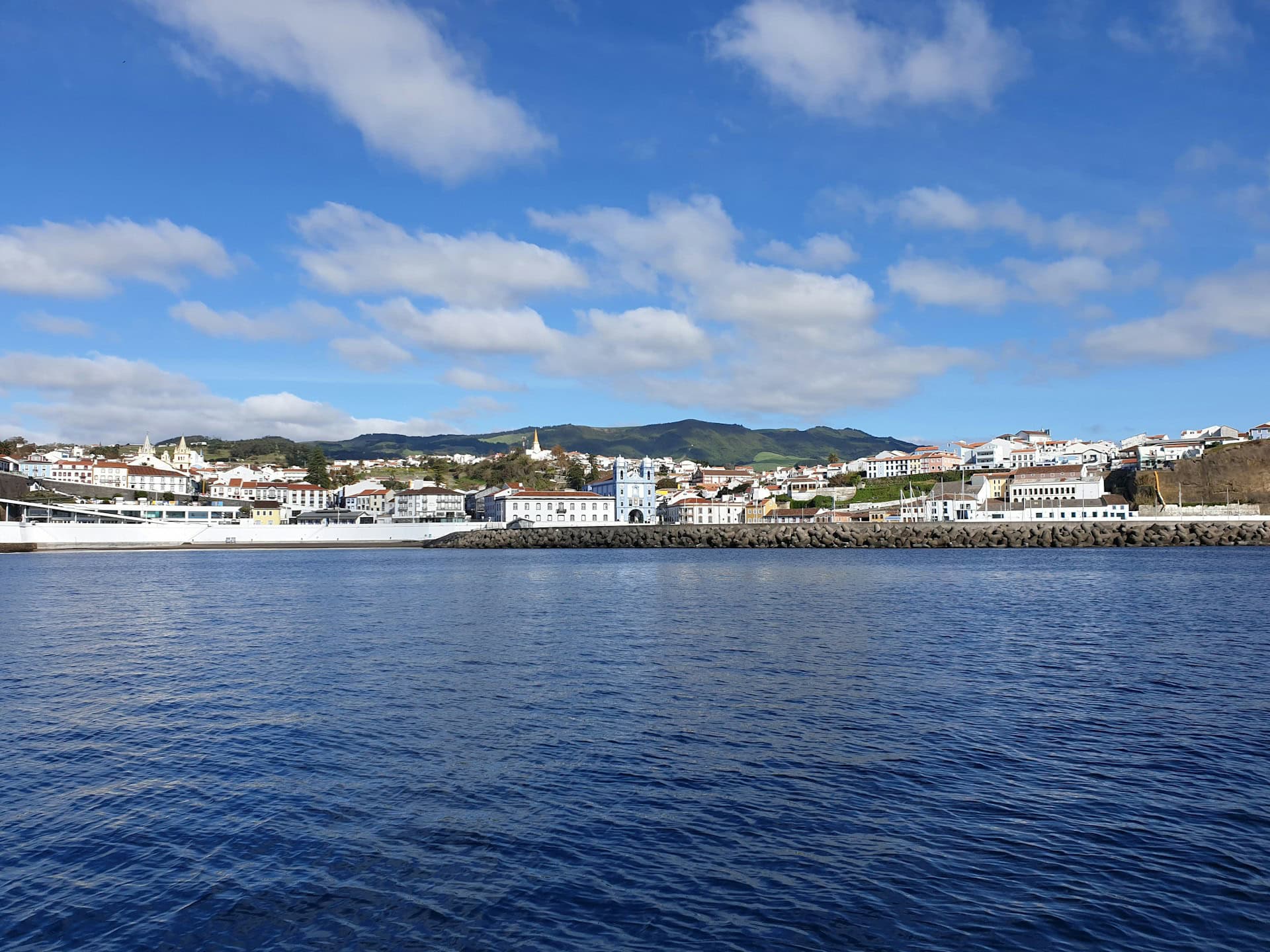
Ponta Delgada is the gateway. João Paulo II Airport handles the most direct connections, and the Laranjeiras complex holds the pool, track, and gym in one place, so you spend less time moving between hard efforts and recovery. From this base you can treat swimming, cycling, and running as customisable components of one trip, which is how a self-directed triathlon training in the Azores itinerary usually comes together.
Other islands earn a place for specific reasons. Terceira, served by Lajes Airport, has hosted triathlon at Praia da Vitória, a bay town with a sheltered sandy beach and a marina. Pico, São Jorge, and Faial, the Triangle islands, offer serious multi-day endurance terrain. Each extra island, though, adds a flight or an Atlânticoline ferry, plus baggage handling and weather risk, which can weaken a short camp. For a first block of one to two weeks, stay on São Miguel and go deep rather than wide.
Use the Piscina das Laranjeiras in Ponta Delgada for reliable technique and intensity work. For open water, swim only in designated bathing areas or with a qualified local guide, alongside a buddy or escort, with a bright tow buoy, the current IPMA maritime forecast, posted beach flags, water-quality alerts, and a clear shore exit planned in advance.

The Piscina das Laranjeiras is described as a 25-metre, six-lane pool with cardio and weight-training facilities, changing rooms, and a sauna (Azores Sports Parks). It is your controlled venue for threshold sets, technique, and any day the ocean is out of bounds. Confirm current public lane access and the timetable before you rely on it, because municipal pools split time between clubs, lessons, and public lanes.
Open-water swimming is realistic but conditional. Sea-surface temperature climbs from about 15.7 C in March to roughly 20 C in June, 22 C in July, and a peak near 23.4 C in August, easing to about 21 C in October (Surf-forecast and SeaTemperatu.re, verified June 2026). Pack a 3/2 mm or 4/3 mm wetsuit and neoprene boots for spring, and a 2 mm top or shorty for late-summer dawn sessions. Always check the live sea-surface temperature and the maritime forecast on the IPMA Portuguese weather service before entering the water, because near-shore readings shift after heavy rain or strong offshore wind.
Respect the Atlantic. The organised Faial to Pico Channel Swim runs under port authorisation with more than 40 safety boats (Discover Faial), which shows both a real open-water culture and the level of supervision that exposed channels demand. Read that as a warning, not an invitation: never treat a channel or an exposed headland as an unsupervised training route. Keep open-water sessions inside monitored bathing areas or under a qualified guide, swim with an escort, wear a high-visibility buoy, and fix your exit point before you start.
Official Biking Azores routes support road, gravel, mountain-bike, climbing, endurance, and skills sessions, with more than 60 classified routes across the islands. The Nordeste to Ponta Delgada road route runs 83 km with 1,782 m of climbing at the hardest Black grade (Biking Azores, verified June 2026). Open traffic, steep descents, wind, rain, and few bailout points all demand careful matching and support.

Note a change worth flagging: the official Biking Azores page now lists the Nordeste to Ponta Delgada road route at 83 km and 1,782 m, where earlier briefs cited about 104 km and 1,803 m. Always read the live route card before you ride, because distance, surface, and status get revised. The page itself warns of demanding climbs, uneven surfaces, cobbled sections through Furnas, and technical descents into Povoação and Vila Franca do Campo.
The climbing is the headline. Cyclists describe the terrain as relentlessly direct and steep, with what locals call Azorian flat resembling the Surrey Hills, and a road feature in Cycling Plus called one São Miguel loop eighty tough but beautiful miles. Traffic is usually light on the older rural roads, since highway upgrades from the 1990s onward pulled most cars onto newer routes, yet riders still report narrow high-elevation lanes, cobbles, and variable driver behaviour. Match the route to the rider, not the rider to the route.
|
Route |
Distance |
Climb / grade |
Use |
Bailout note |
|
Sete Cidades circular |
Approx 16.5 km |
Moderate |
Skills, easy spin, scenery |
Short loop; easy return to start |
|
Ponta Delgada to Lagoa do Fogo |
Approx 50 km |
High point approx 1,349 m, 3 h |
Sustained climbing |
Cloud at top; descend if wind rises |
|
Volta ao Concelho |
Approx 84.4 km |
Difficult |
Endurance |
Plan resupply; few late bailouts |
|
Nordeste to Ponta Delgada |
83 km |
1,782 m, Black, 4-5 h |
Big endurance day |
Open traffic, technical descents |
|
East-end circuit |
Approx 91.2 km |
Hard, 4-5 h |
Long endurance |
Remote sections; carry spares |
Route cards: source Biking Azores route directory and cycling press. Verified 25 June 2026. Recheck road and route status before each ride.
Support exists if you plan ahead. The Biking Azores riding-support directory for São Miguel lists bike rental, specialist guides, workshops, washing, transfers, and cycling-friendly accommodation. Confirm each provider directly before you commit a session to it.
Azores trails build climbing strength and durability, while the Laranjeiras synthetic track gives you controlled intervals and race-pace work. Constant hills and technical trails cannot replace every session a flat long-course race demands, so plan flatter waterfront or road loops for race-pace efforts and field-check them for true distance and surface.
For structured speed, the Laranjeiras complex includes an eight-lane synthetic athletics track, which gives intervals and race-pace work a measured, controlled venue (Azores Sports Parks). Confirm public access and the timetable before counting on it. For volume and strength, the official Azores Trails network publishes distance, elevation, difficulty, downloadable route files, and live status, which makes route selection safer when conditions turn.
The running culture is real and visible in events. The Azores Trail Run series lists a São Miguel festival across several distances, a three-day Triangle Adventure spanning Pico, São Jorge, and Faial, and the Whalers Great Route on Faial at roughly 70 km with about 2,370 m of ascent. Treat these as evidence of terrain and community, and verify any current-year dates directly. For how that trail terrain actually feels underfoot, the Azores.com guide to Azores trail terrain is a useful companion before you plan long runs.
Keep one honest limitation in view. Long, genuinely flat stretches are scarce on São Miguel, so the island over-prepares climbing legs and under-prepares flat race rhythm. If your target race is a flat long-course event, build dedicated race-pace sessions on the track or on a field-checked waterfront loop, and accept that the Azores trains durability better than it trains flat speed.
A coach-reviewed week could combine an easy arrival swim, hill-bike intervals, controlled track work, a supervised open-water swim, a long hilly ride, an easy trail run, and one short brick, wrapped around recovery. Volume and intensity stay individual. Treat the block below as a structure to adapt with your own coach, never as a universal prescription.
The structure pairs hard volcanic days with controlled venues, and it builds a weather backup into every session. It assumes a São Miguel base near Ponta Delgada, with the pool and track at Laranjeiras.
|
Day |
Main session |
Second session |
Weather backup |
|
1, arrival |
Travel and bike build |
Easy 20-30 min pool swim, technique |
Shake out after the flight |
|
2 |
Hill-bike intervals, Lagoa do Fogo lower slopes |
Easy mobility |
Wind: indoor trainer or gym |
|
3 |
Track intervals at race pace, Laranjeiras |
Easy recovery swim |
Rain: pool session only |
|
4 |
Supervised open-water swim, designated area or guide |
Easy spin or rest |
Swell or warning: move to pool |
|
5 |
Long hilly ride, 60-90 km, Sete Cidades and coast |
Recovery walk |
Storm: shorten loop or use trainer |
|
6 |
Easy trail run, graded Azores Trails route |
Short brick, bike to run 20-30 min |
Trail closed: track or waterfront |
|
7 |
Recovery, easy swim or full rest |
Travel preparation |
Reassess load before departure |
Sample week: requires sign-off from a qualified triathlon coach before publishing. Adapt all volumes and intensities to the individual athlete.
Reserve bicycle space with Azores Airlines in advance, confirm the current weight, packing, and battery rules, and arrange a transfer vehicle that fits a bike box. Verify workshop and rental access through Biking Azores, and carry fit-specific spares. Inter-island ferries add handling, schedules, and weather complexity that can weaken a short camp.
Bike logistics decide whether a camp starts well. Book early, declare your equipment, and pack to the airline’s exact rules, because sports baggage on these routes needs confirmation and carries fees.
Airline and ferry rules: source Azores Airlines and Atlânticoline. Verified 25 June 2026. Reconfirm fare-specific allowance and battery limits before travel.
Atlantic swell, fast-changing weather, open roads, technical descents, steep terrain, and a less mature camp ecosystem all demand flexibility. Avoid solo ocean swims, confirm every facility before you rely on it, use local route knowledge, keep easy-day options in reserve, and carry travel and activity insurance that covers each of your disciplines.
Weather is the first variable, not the last. The Azores are famously changeable, and a clear climb can turn into a wet, wind-exposed descent within an hour. Build the weather-backup system below into the plan rather than hoping for a dry week.
|
Trigger |
Session affected |
Backup action |
|
High swell or wind warning on IPMA |
Open-water swim |
Move to the Laranjeiras pool |
|
Heavy rain or wet roads |
Long descent ride |
Shorten the loop, ride lower elevations, or use a trainer |
|
Strong wind at altitude |
Climbing ride |
Switch to a sheltered coastal road or the track |
|
Trail closed or red status |
Trail run |
Track intervals or a waterfront road run |
|
Strong sun, occasional |
Midday efforts |
Shift sessions to dawn or dusk |
The other risks follow from terrain and maturity. Open water near channels and headlands needs supervision, never a solo swim. Roads carry real traffic, with steep technical descents, cobbles, and narrow high-elevation lanes that reward local knowledge. The camp ecosystem is thinner than mainland Europe, so you self-direct or hire local guides rather than join a packaged programme. Regional triathlon has been organised in the Azores, at Praia da Vitória on Terceira and at Ponta Delgada on São Miguel, but confirm any current edition directly, and note there is no sanctioned IRONMAN event in the archipelago. Finally, confirm pool lane times and track access in writing, because public timetables change, and carry insurance that explicitly covers swimming, cycling, and running abroad.
The decision rules are simple. Choose the Azores if you can train around the weather, swim supervised, respect long volcanic climbs, and book bike logistics early. Base yourself on São Miguel near Ponta Delgada, use the Laranjeiras pool and track as controlled venues, and treat the ocean and the mountains with the caution they ask for. The matrix, route cards, sample week, weather-backup table, and bike checklist above are your planning spine.
Before you book, verify the details that move: live sea-surface temperature and the maritime forecast on IPMA, public lane and track timetables at Laranjeiras, route and road status on Biking Azores and Azores Trails, current Azores Airlines and Atlânticoline bike and battery rules, and any current-year event dates.
If you would rather hand the logistics to people who live on the islands, Azores.com has planned trips here since 1996. Tell us your dates and disciplines, and we can craft a custom Azores active holiday with bike transport, suitable accommodation, guided routes, and weather-flexible scheduling. Clubs, coaches, and athletes who need a fuller setup can request a private triathlon training itinerary and we will build the week around your training, not a template.
SUPPORTING PRODUCTION MATERIAL
Image and alt-text plan
Every image must support a specific section or attribute. Decorative destination photography alone is insufficient. Use descriptive filenames and alt text that name the visible subject, island or location, activity, and relevant attribute. Label maps, route profiles, and the matrix with source and verification date.
|
Placement |
Filename |
Alt text |
Note |
|
H2 3, swimming |
open-water-swim-buoy-sao-miguel-azores.jpg |
Triathlete open-water swimming with a bright tow buoy beside a guide in a designated bathing area, São Miguel, Azores |
Show supervision and buoy |
|
H2 4, cycling |
road-cycling-nordeste-route-sao-miguel-azores.jpg |
Cyclist climbing a verified Biking Azores road route above the coast near Nordeste, São Miguel, Azores |
Use a real official route |
|
H2 5, running |
laranjeiras-track-intervals-ponta-delgada.jpg |
Runner on the eight-lane synthetic athletics track at the Laranjeiras complex, Ponta Delgada, Azores |
Controlled track session |
|
H2 4 or matrix |
nordeste-pdl-route-elevation-profile-2026.png |
Elevation profile of the 83 km Nordeste to Ponta Delgada road route, 1,782 m climb, verified June 2026 |
Label source and date |
|
H2 2, base map |
sao-miguel-three-discipline-base-map.png |
Map of São Miguel showing the Ponta Delgada base, Laranjeiras pool and track, and swim, bike, and run zones |
Descriptive alt text |
Is your time too precious to spend long hours searching for the perfect holiday in the Azores? Looking for expert help in organizing your trip? Hire an Azores.com Travel consultant.
Let us find the right itinerary for your Azores group travel needs. From family reunions to team building, we're here to help. From Sao Miguel to Flores, we guarantee the best service!

Have a question about traveling to Azores? Need more info about booking tour packages, day tours, activitis hotels or car in Azores? Click below to contact us.

Read Azores.com reviews on Trustpilot.com.