Travel Consultants
Is your time too precious to spend long hours searching for the perfect holiday in the Azores? Looking for expert help in organizing your trip? Hire an Azores.com Travel consultant.


By the Azores.com Travel Team. Last updated June 2026.
Azorean natural pools use volcanic rock, sheltered coves, or low sea walls to calm the water, yet every one of them stays connected to the open Atlantic. The best pool for you depends on seven things you can actually check: the island, the tide, the swell and wind, the access steps, the water depth, the current water quality, and whether a lifeguard is on duty. Get those right and you choose a swim that fits your confidence, your group, and the conditions on the day.
This guide walks the decision in the order that matters. First, what separates a natural pool from a beach. Then which islands suit which kind of swimmer, with an island-by-island matrix you can save. After that, how tides, swell, and wind change a pool hour by hour, where to check official water quality and warnings, what to know about the Portuguese man o’ war, and finally which pools suit children and less-confident swimmers. The one limitation to hold onto from the start: these are living Atlantic environments, not enclosed hotel pools. A spot that is gentle at low tide can turn dangerous on the same afternoon, so the live flag and the official forecast always outrank any guidebook, including this one.
How we checked this: facts on bathing-water status, seasons, and safety come from official Azorean and Portuguese sources, linked throughout. Conditions change, so we point you to live tools rather than copying readings that go stale.
An Azores natural pool is a swimming area shaped by volcanic basalt, a sheltered cove, or a built-up sea wall that softens the waves, while the water itself flows in straight from the Atlantic. Depth, swell, tide, entry steps, and lifeguard cover vary widely between sites and seasons. A pool is calmer than open coast, not separate from it.
That difference shapes everything about your swim. A sandy beach gives you a gradual entry and a shifting shoreline. A natural pool, like the basalt formations at Biscoitos on Terceira or the lava-rock bay at Caloura on São Miguel, gives you clear, deeper water held inside dark rock, reached by steps or a ladder rather than a slope. The reward is glassy water and visibility that snorkelers and divers prize. The trade-off is a hard, sometimes slippery edge, and the same swell that breaks harmlessly on a beach can wash across a pool wall without warning.
The Azores hold this kind of swimming in unusual abundance. The Regional Government of the Azores confirmed 88 official coastal bathing waters for the 2026 season, spread across all nine inhabited islands, according to the regional bathing-water decree summarized in April 2026. Pico leads with 26 designated areas, São Miguel follows with 25, and Terceira holds 16, while Corvo maintains a single official bathing area at the heart of island life. That scale is exactly why a decision guide helps: with this many options, the question is not whether you can swim, but which pool fits you on a given day.
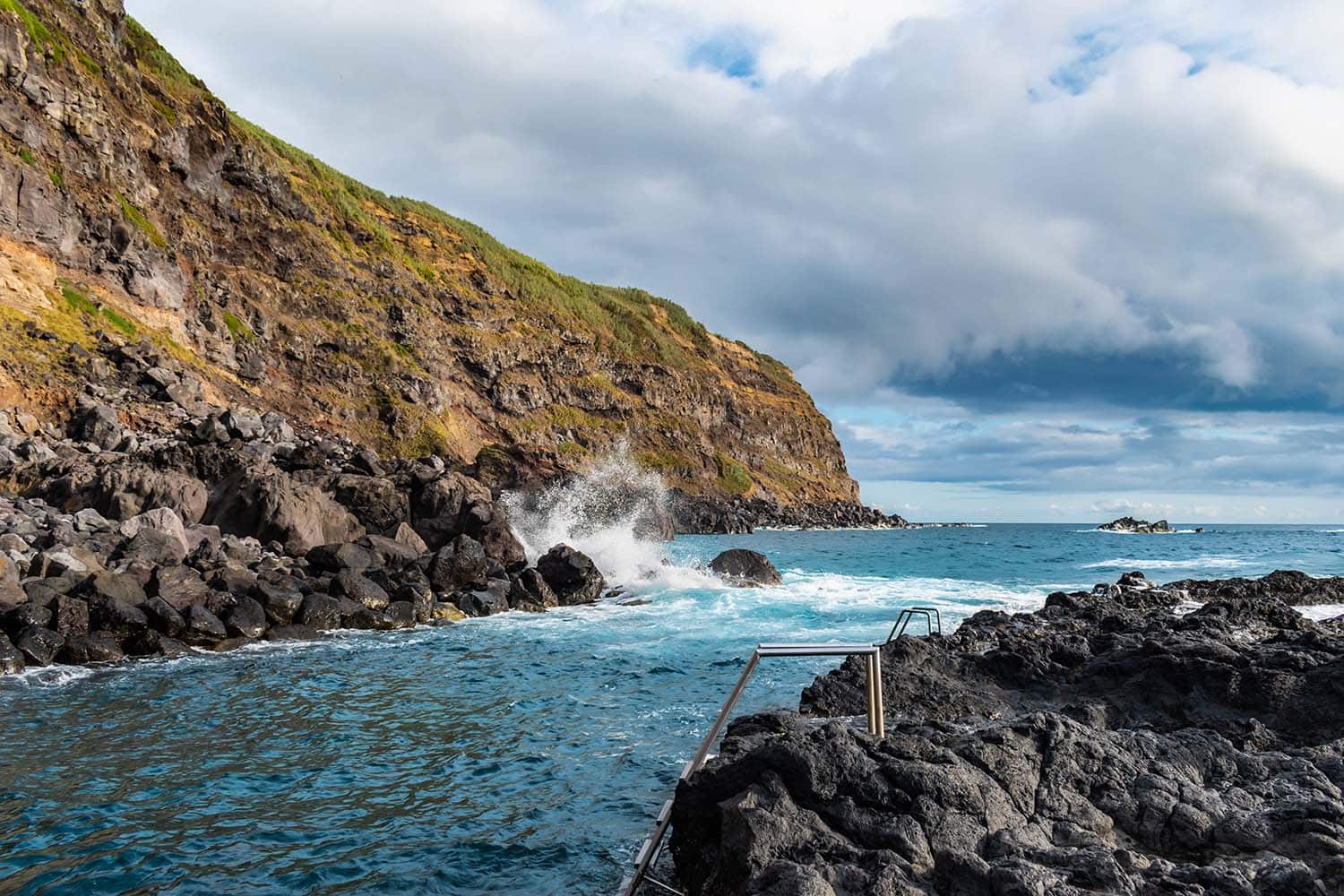 Natural Swimming Pools in Ponta da Ferraria in São Miguel Island, Azores.
The best island depends on what you want from the water. Choose São Miguel for variety and a rare thermal ocean soak, Terceira for the photogenic basalt pools of Biscoitos, Faial for monitored family pools with full facilities, Pico for raw lava-rock swimming, Graciosa for a gentle enclosed pool, and Flores or Santa Maria for quiet, scenic dips. Match the pool to your confidence, access needs, and season.
Here is the planning asset to save. The matrix below maps the most established natural pools by island against the attributes that decide your swim. Treat the season and facility columns as a starting point, not a promise, because the regional decree sets bathing dates for each location individually and facilities open and close with the season.
The full swimming matrix follows on the next page.
|
Pool (island) |
Pool type |
Access |
Tide / swell dependence |
Exposure |
Lifeguard (bathing season) |
Facilities |
Family suitability |
|
Ponta da Ferraria (São Miguel) |
Thermal ocean cove |
Two fixed ladders, safety ropes, rocky |
High. Warm only near low tide; arrive within about 2 hours of low tide |
Exposed to swell at high tide |
Seasonal, peak hours only |
Café and paid parking above, summer shuttle; minimal at water |
Low to moderate. Deep, rope-assisted, currents. Not for young children |
|
Caloura (São Miguel) |
Lava-rock sea pool in a sheltered bay |
Steps and ladders into the bay |
Low to moderate |
Sheltered by rock, usually calmer |
Check official list for the year |
Toilet, shower, small children’s pool, nearby restaurant |
Moderate to good (small kids’ pool) |
|
Piscinas Naturais dos Mosteiros (São Miguel) |
Lava tidal pools |
Short path from village parking, rocky |
Tide dependent |
West coast, sunset-facing, can be exposed |
Seasonal at the main pool |
Some facilities, parking |
Moderate |
|
Ilhéu de Vila Franca do Campo (São Miguel) |
Crater-islet lagoon |
Boat only, regulated, daily capacity limit |
Sheltered lagoon |
Protected nature reserve |
Managed access, reopened for 2026 |
Boat ticket required; limited on-islet |
Moderate. Book ahead; capacity capped |
|
Biscoitos (Terceira) |
Basalt lava pools |
Walkways, steps, ladders |
Tide and swell dependent |
North coast; swell exposure on windy days |
Commonly mid-June to end of September |
Changing rooms, showers, bar, free parking; Blue Flag |
Good when calm and monitored |
|
Cachorro / Poça Branca (Pico) |
Lava-rock pools |
Rocky, steps |
Tide and swell dependent |
Exposed, largely unmonitored |
Mostly none |
Minimal |
Low (no lifeguard) |
|
Varadouro (Faial) |
Semi-natural pools |
Steps, some step-free access |
Tide and swell dependent |
South coast |
Summer season |
Showers, toilets, bar, accessibility provision |
Good (monitored) |
|
Castelo Branco (Faial) |
Cement-reinforced semi-natural pools |
Steps |
Moderate |
South coast |
Through the summer |
Facilities on site |
Good |
|
Carapacho (Graciosa) |
Basalt pools plus an enclosed pool |
Steps and ladders |
Tide dependent |
South coast |
Seasonal |
Enclosed children’s pool, spa nearby |
Good (enclosed kids’ pool) |
|
Preguiça / Velas (São Jorge) |
Coastal bathing areas |
Steps and ladders |
Moderate |
Near Velas |
Seasonal |
Well-equipped bathing area |
Moderate to good |
|
Santa Cruz das Flores pools (Flores) |
Volcanic-rock pools |
Steps |
Moderate |
Calm and clear in settled weather |
Seasonal |
Facilities in town |
Moderate to good |
|
Praia Formosa (Santa Maria) |
Sandy beach (warm-water alternative) |
Beach entry |
Standard beach tide |
Sheltered bay |
In season |
Full beach facilities |
Good |
Notes: season and facility details follow the annual regional bathing-water decree and can change, so confirm dates and lifeguard cover for your specific pool before you travel. Water quality for every designated site is published on APA Info Água and the island DRPM bulletins; live sea state is on IPMA; live webcams and tide times are on spotazores.com. Sources accessed 25 June 2026.
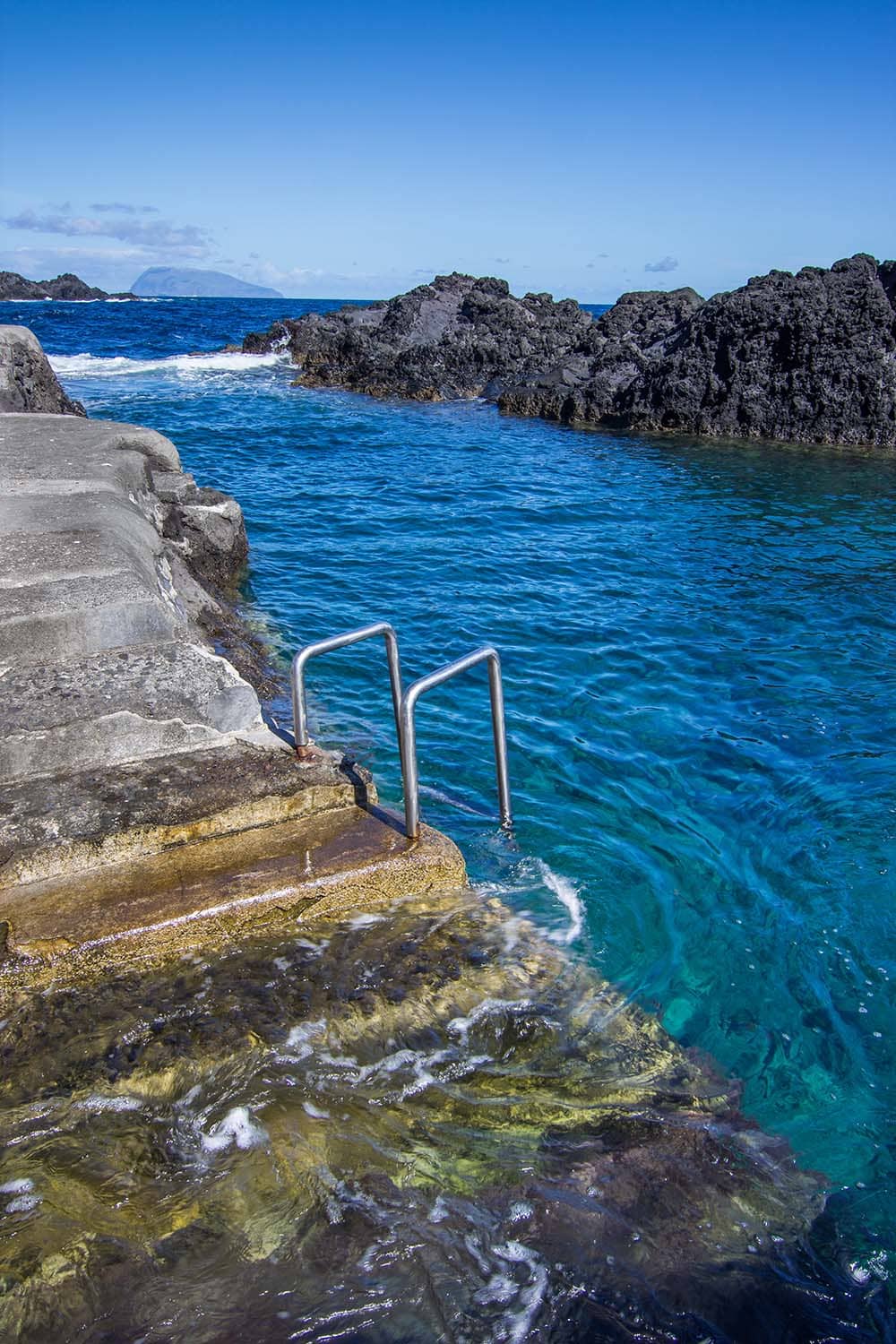
Natural Pools Santa Cruz, Flores Island, Azores.
Once you know the swimmer you are planning for, the rest of the trip falls into place around the water. Active travelers who want to pair pools with coasteering, snorkeling, and guided hikes can build the swimming days into Azores active holidays rather than leaving them to chance. If your group spans confident swimmers and cautious ones, lean toward islands with monitored, full-facility pools such as Faial and Terceira, and keep the wilder lava pools of Pico for the strong swimmers in calm conditions only.
Tide, swell, and wind decide whether a pool is inviting or hazardous on any given hour. Low tide can open up access and reveal sheltered water at some pools, while high tide and incoming swell can push waves across walls and over entry steps. Wind raises chop and drives surface drift. Check the live flag, the marine forecast, and a webcam immediately before you enter, every time.
Ponta da Ferraria on São Miguel is the clearest example of tide-driven planning. This free thermal spot, where volcanic heat seeps into an ocean cove, only delivers its warmth as the tide drops: bathers report water near 28 degrees Celsius close to low tide and closer to 18 degrees Celsius at high tide. The recommendation from those who swim it is to arrive within roughly two hours of low tide. The same falling tide that warms the cove also calms it, while a rising tide brings colder, rougher water over the rocks. Fixed ladders and crisscrossing safety ropes help you hold position, because the tide genuinely can pull a swimmer out, and the ropes are there to grab when the water gets too deep underfoot.
Swell and wind matter even where the water looks calm. The Government of Canada’s official travel advice for the Azores, updated on 23 June 2026, warns that coastal waters can be dangerous even for excellent swimmers, that ocean currents are powerful, that rip currents are common, and that drownings occur every year. It also notes that the Portuguese Maritime Police can fine you for ignoring a warning flag. Read the flags as instructions, not decoration. On exposed sites such as the north-coast pools of Pico or the wilder spots on Faial outside Varadouro and Castelo Branco, a windy day can make an unmonitored pool unsafe regardless of how it photographs. When you are unsure, choose a monitored pool, or skip the swim.
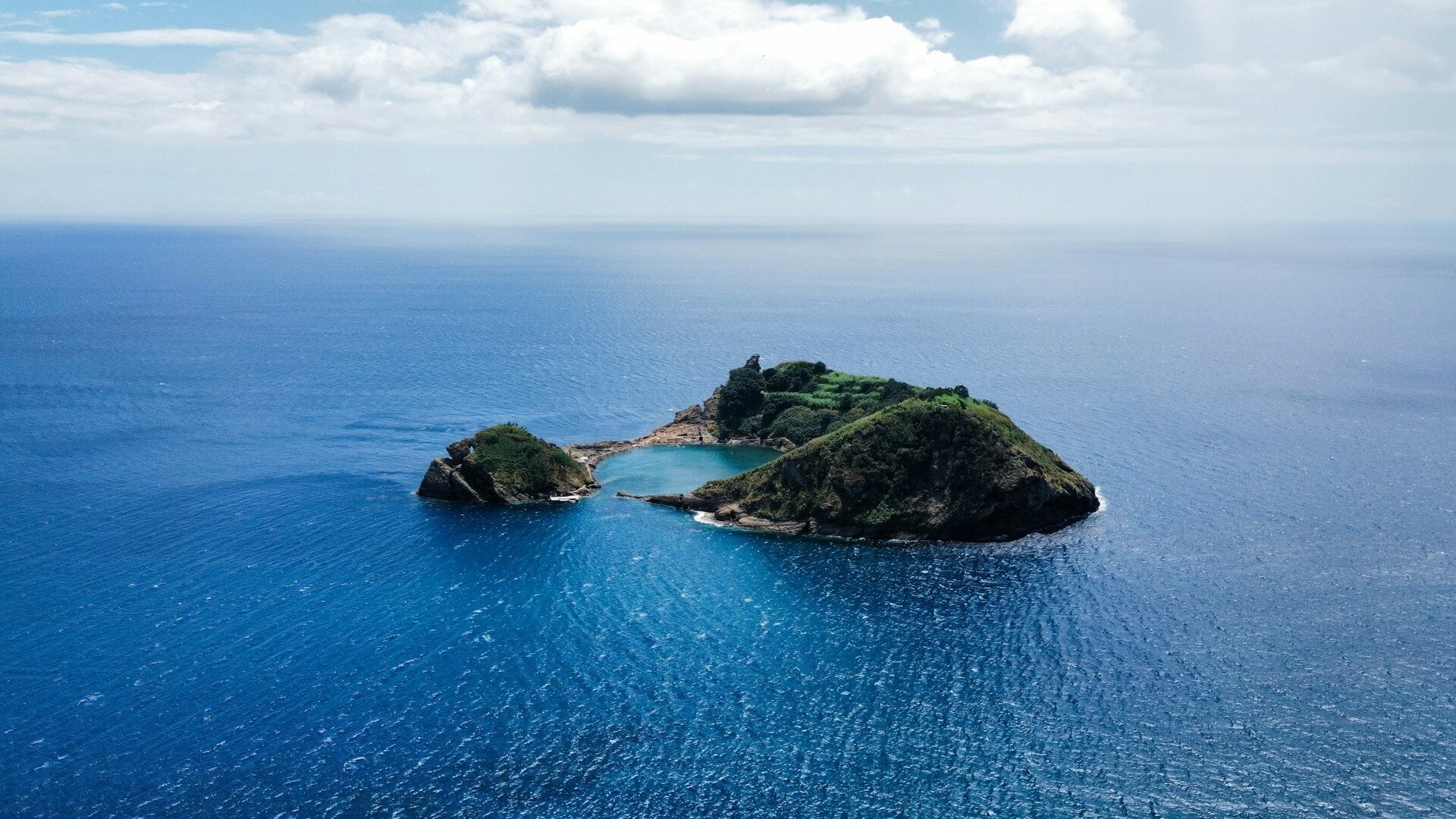
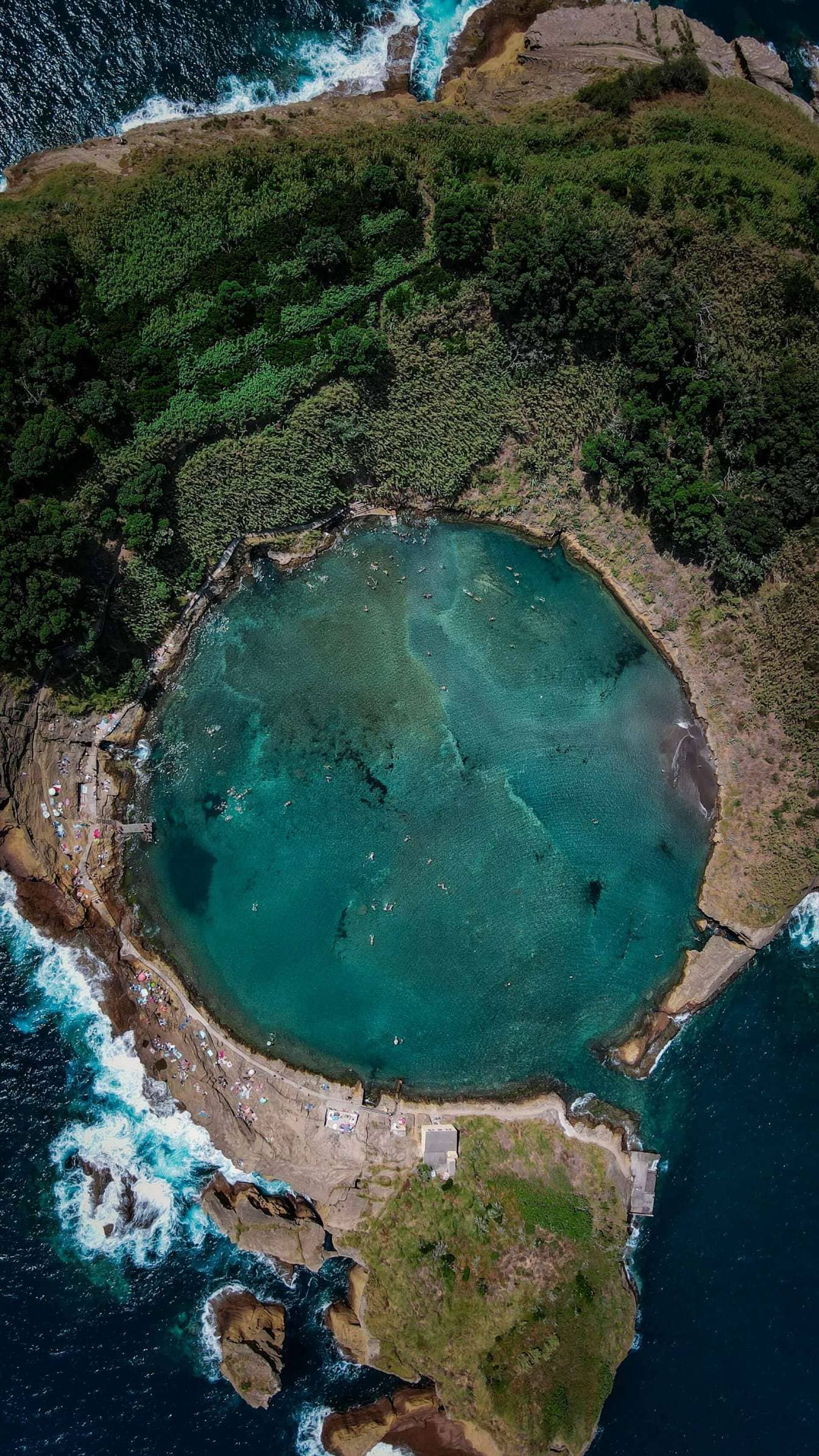 Ilhéu de Vila Franca do Campo São Miguel island
Two official systems carry the information you need. The national Info Água portal, run by the Portuguese Environment Agency (APA), publishes bathing-water quality and active alerts for designated sites, and the Regional Government of the Azores issues island-level coastal bathing-water bulletins. Local flags, on-site lifeguards, municipal notices, and live webcams still matter most, because quality, swell, closures, and marine-life warnings can shift within a day.
Use the right tool for each question. For water quality and contamination alerts, check the APA Info Água beaches portal, which is the national reference for whether a designated bathing water is currently rated as expected or flagged. For the sea state before an open-water swim, the Portuguese Institute for Sea and Atmosphere (IPMA) publishes a maritime forecast for wind, waves, and sea conditions, plus a separate sea-surface temperature service that helps you judge wetsuit use rather than guessing from seasonal averages. For real-time eyes on a specific pool, spotazores.com streams live webcams and tide times from locations across the islands, which is how many local swimmers decide whether today is a Ferraria day. Bookmark these before you travel, and treat the reading you take on the morning of your swim as the one that counts.
A word on the official bathing list itself. The 88 designated bathing waters are the sites where water quality is monitored and where lifeguards and basic facilities are most likely to be present during the season. That makes the list a useful filter: a designated, monitored pool carries more support than an unlisted rock pool, however beautiful the unlisted one looks. Bathing seasons in the Azores do not start and end on a single date across the region; the decree sets them per location, so confirm the dates for your specific pool and travel window before you rely on lifeguard cover.
The Portuguese man o’ war (Physalia physalis) is the most venomous marine animal you are likely to meet in Azorean waters, and it can appear at any swimming area when wind and currents bring it ashore. It cannot swim, so it drifts wherever the weather pushes it, recognizable by a translucent float tinted pink, purple, and blue. Never touch one, even when it is stranded and looks dead, because detached tentacles can still sting.
The man o’ war arrives mainly in spring and early summer, carried by onshore wind, and it tends to show up at several beaches at once before moving on. This is precisely the situation where travelers want a backup plan: when purple flags or stranded floats appear at one pool, move to a sheltered, monitored alternative or wait for clearer conditions. The presence of a man o’ war is a reason to obey the flag and stay out, not a risk to manage on your own.
First aid for a man o’ war sting is genuinely contested in the medical literature, which is why the safe move is to follow official local guidance rather than internet folk remedies. If you or someone in your group is stung, get out of the water, alert the lifeguard, and call 112, the European emergency number used across the Azores. Do not rub the area, and do not apply urine, which is an old myth with no benefit. Researchers continue to debate the role of vinegar and hot-water immersion, so defer to the lifeguard, 112, or the SNS 24 health line for the current protocol. Serious or widespread stings, or any breathing difficulty, are a medical emergency.
Family suitability comes from monitored, sheltered water with easy exits, not from how a pool looks in a photo. The most child-friendly options pair a protected or enclosed section with a lifeguard, shallow entry, handrails or steps, toilets, and changing facilities. Carapacho on Graciosa, with its enclosed children’s pool, and Caloura on São Miguel, with its small kids’ pool, are good starting points. Choose a monitored pool, supervise closely, and leave the moment a flag or the conditions change.
For families, the facilities are the feature. A pool with showers, toilets, a nearby café, and a lifeguard, such as Varadouro or Castelo Branco on Faial, or Biscoitos on Terceira when conditions are calm, turns a swim into a manageable half-day rather than a logistical gamble. Look for an enclosed or rock-protected section where younger children can paddle away from the open edge, and check that the entry is by gradual steps rather than a single deep ladder. The bathing-season window matters most here, because that is when lifeguards are on duty and facilities are open; outside it, the same pool becomes an unmonitored swim.
Set the ground rules before anyone gets in. Keep children within arm’s reach in natural pools, because depth changes quickly beside volcanic rock and swell can arrive without much warning. Water shoes are worth packing for every member of the family, since the basalt is slippery and the intertidal zone hides sea urchins alongside the occasional jellyfish. For more ways to build island days around younger travelers, see our guide to family-friendly Azores activities. And if conditions turn, treat the decision to skip a swim as part of the plan, not a disappointment.
Most Azores natural pools are free public bathing areas, including Biscoitos on Terceira and Ponta da Ferraria on São Miguel, though you may still pay for parking or a summer shuttle. The Ilhéu de Vila Franca do Campo is the main exception, reached only by a paid, capacity-limited boat.
Water shoes are strongly recommended at most Azores natural pools. The basalt underfoot is slippery and often sharp, and the intertidal zone can hide sea urchins. Sandy beaches such as Praia Formosa on Santa Maria are the exception, where you can wade in barefoot.
The official bathing season runs roughly from June to September, when lifeguards are on duty, facilities are open, and the sea is warmest in late summer. The regional decree sets exact dates per location, so confirm your pool’s season and check the IPMA sea-surface temperature before you travel.
Many swimmers are comfortable without a wetsuit from July to September, when the surface water is warmest, while a wetsuit helps in the cooler shoulder months and for long open-water sessions. Check the current IPMA sea-surface temperature rather than relying on seasonal averages.
Pico has the most designated coastal bathing waters, with 26 approved sites for the 2026 season, followed by São Miguel with 25 and Terceira with 16, according to the regional bathing-water decree. Corvo has a single official bathing area.
You can enter many Azores natural pools outside summer, but beyond the June to September bathing season there are no lifeguards, facilities close, the sea is colder, and winter swell makes exposed pools hazardous. Swim only in sheltered, settled conditions, and always check the flag and the IPMA forecast first.
Choosing well comes down to a short sequence. Pick the island for the kind of swimming you want, shortlist designated and monitored pools over unlisted rock pools, match the pool to the least confident swimmer in your group, and then let the live conditions make the final call. Tide, swell, wind, water quality, and lifeguard cover are the five variables that turn a good choice into a safe one.
Before you lock in dates, verify four things for your specific travel window: the official bathing-season dates for your chosen pools, the current water-quality status on the APA Info Água portal, the IPMA marine forecast for your swim days, and whether the pool you are counting on has a lifeguard when you plan to be there. For thermal Ponta da Ferraria, add a fifth, the low-tide times, and plan the day around them.
That is where a specialist who knows the islands earns their keep. Since 1996, the Azores.com team has built single and multi-island trips around exactly these questions, pairing the right pools and water activities with accommodation near the swimming zones you care about, on every one of the nine islands. Tell us your dates, your group, and how adventurous your swimmers are, and we will craft an itinerary that puts you at the right pool on the right tide. Save the matrix above, check the live links on the morning of each swim, and let us handle the planning around the water.
Choosing the right pool on the right day is easier with a specialist beside you. The Azores.com team has planned island trips since 1996, and we will match you with the tour package that best fits how and where you want to swim. That might be a São Miguel self-drive timed around Ponta da Ferraria’s low tides, a Faial and Terceira family trip built on monitored, full-facility pools, or an active multi-island holiday that pairs swimming with hiking, snorkeling, and whale watching.
Have specific pools in mind? Tell us the exact natural pools you want to swim, your travel dates, and your group, and we will craft a tailor-made itinerary that reaches each one in the right order. We pair every swim with accommodation nearby and a plan that flexes when the tide, swell, or forecast changes, so you spend the trip in the water rather than second-guessing the logistics.
Tell us your dates and your must-swim pools, and we will build your Azores trip around them. Get a personalized quote to start.
|
Filename |
Alt text |
Caption |
Section |
Source / verification |
|
biscoitos-natural-pools-terceira-basalt-overview.jpg |
Basalt natural pools at Biscoitos, Terceira, with swimmers in sheltered lava-rock bays |
The basalt pools at Biscoitos, Terceira |
What makes a pool different |
Original field photo required |
|
ponta-da-ferraria-low-tide-thermal-cove-sao-miguel.jpg |
Ponta da Ferraria thermal ocean cove at low tide with safety ropes and ladder access, São Miguel |
Ponta da Ferraria near low tide, with safety ropes |
Tides, swell, and wind |
Original field photo required; shoot near low tide |
|
azores-bathing-warning-flags-lifeguard-post.jpg |
Warning flags at an Azores bathing area showing the current safety status beside a lifeguard post |
Read the flag before you enter |
Tides, swell, and wind |
Original field photo; do not mock up safety symbols |
|
caloura-natural-pool-steps-access-sao-miguel.jpg |
Steps and ladder entry into the lava-rock sea pool at Caloura, São Miguel |
Step access into the sheltered bay at Caloura |
Which islands |
Original field photo required |
|
portuguese-man-o-war-stranded-azores-warning.jpg |
Stranded Portuguese man o’ war on an Azores shoreline, blue and purple float, do not touch |
A stranded man o’ war; detached tentacles still sting |
Portuguese man o’ war |
Original field photo; verify species with caption |
|
carapacho-enclosed-childrens-pool-graciosa.jpg |
Enclosed children’s pool beside basalt rocks at Carapacho, Graciosa, with shallow water and steps |
The enclosed children’s pool at Carapacho, Graciosa |
Pools for children |
Original field photo required |
Is your time too precious to spend long hours searching for the perfect holiday in the Azores? Looking for expert help in organizing your trip? Hire an Azores.com Travel consultant.
Let us find the right itinerary for your Azores group travel needs. From family reunions to team building, we're here to help. From Sao Miguel to Flores, we guarantee the best service!

Have a question about traveling to Azores? Need more info about booking tour packages, day tours, activitis hotels or car in Azores? Click below to contact us.

Read Azores.com reviews on Trustpilot.com.